- LessonsLearned
- Posts
- Why is the sky blue?
Why is the sky blue?

Krishnawidya Krishnawidya
September 14, 2025

TL;DR: Molecules in our atmosphere scatter the shorter, bluer wavelengths of sunlight much more strongly than the longer, redder ones.
Reading time: Faster than waiting for your morning cuppa.
One of the earliest questions we encountered as a kid.. “Why is the sky blue?” If you pose this question to adults, many will reply with half-remembered glimpses about diffraction, sunlight, reflection off the ocean, blablabla. And yet you still wonder what all those mean and you leave the conversation still in confusion about the reason behind the sky’s blue-ish colour. So let’s clear it up and strap yourself for a clear day.
Birth of scattering theories
By the mid-19th century, experiments by John Tyndall showed that when fine particles are suspended in a medium, the light scattered sideways is both blue and completely polarised. Tyndall noted that this blue light increases as one moves toward the shorter (more refrangible) wavelengths of the spectrum, which is an important clue that the colour depends on wavelength rather than on the colour of the particles themselves. However, Tyndall did not yet explain how tiny particles scatter light.
In 1871, the young physicist John William Strutt (Lord Rayleigh - yeap the famous Rayleigh theory) published a theoretical explanation. He argued that the light from the clear sky arises from minute suspended particles or molecules that deflect sunlight out of its direct path. He reasoned that the relevant length scale is the wavelength of light; particles much smaller than this scatter light with a strength that increases dramatically toward shorter wavelengths.
Rayleigh’s calculations showed that the scattering cross-section, sigma, for a particle in the electric dipole limit, depends on the wavelength as:

In other words, blue light (which is approximately 400 nm) is scattered about nine times more strongly than red light (which is approx. 700 nm). He also predicted that the scattered light would be polarised at right angles to the original beam, which was a feature that Tyndall observed but not explained. With this theory, Rayleigh established that the sky’s blueness is not a reflection of the ocean, nor a property of the air itself, but rather a consequence of how sunlight interacts with tiny molecules in the atmosphere.
Modern measurements confirm and refine Rayleigh’s theory. A 2019 study published in Journal of Quantitative Spectroscopy & Radiative Transfer notes that Rayleigh scattering is the dispersion of electromagnetic radiation by particles significantly smaller than the wavelength of the incident light. The authors emphasise that because the scattering intensity is proportional to the inverse fourth power of wavelength (equation in the above image), shorter wavelengths scatter more, leading to our blue sky. They noted that the best known example of this wavelength dependence is precisely, “the appearance of a blue Earth sky from Rayleigh scattering of incoming solar radiation in our nitrogen-rich atmosphere.”
Furthermore, NASA’s Rayleigh scattering primer supports this result. The primer notes that infrared light is very weakly scattered, while ultraviolet is even more strongly scattered than blue. This wavelength dependence means that as sunlight enters the atmosphere, the violet and blue components are preferentially scattered in all directions; some of those scattered photons reach our eyes when we look away from the sun in a blueish hue colour.
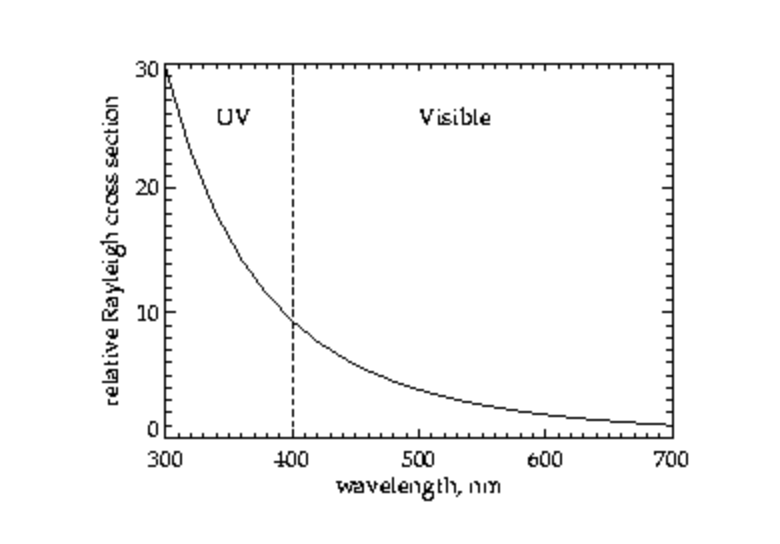
But why don’t we perceive the sky as violet then? Two reasons:
First, the sun emits less energy in the violet than in the blue. And second, our eyes are less sensitive to violet wavelengths.
Myths
Many popular explanations incorrectly invoke “diffraction by clouds”. This is incorrect. Diffraction (the bending of light around obstacles) does occur in the atmosphere, but it produces halo and corona effects around the sun and moon, not the global blue colour that we see. Another persistent myth is that the sky’s colour comes from the reflection of the ocean. In reality, the ocean appears blue partly because it reflects the blue sky 🙂 not the other way around. Another misconception is that the Tyndall effect (scattering by colloidal particles) explains the blue sky. However, the Tyndall effect is a macroscopic analogue of Rayleigh scattering. It occurs when tiny smoke or dust particles scatter light in a laboratory, but the clear sky is free of visible dust. The scattering in the sky occurs because of nitrogen and oxygen molecules.
Okay so what about sunset and twilight?
To answer that question, let me ask another question - if blue light is scattered in all directions, what happens to the sunlight that continues along our line of sight to the sun?
Because blue light is preferentially removed, the direct sunlight we see from the sun becomes depleted in blue and enriched in red and orange. When the sun is high in the sky, the light path through the atmosphere is short, and only a fraction of blue light is scattered, so the sun appears yellow.
At sunset, the light path is much longer, which means most of the blue and green is scattered out, leaving the Instagram-worthy orange/red colour.
And the same goes with what happens during pink twilight and golden hours. As sunlight travels through the lower atmosphere, fine particles and ozone selectively scatter and absorb different wavelengths, painting the sky with subtle gradations of colour. The Atmospheric Chemistry and Physics study shows that ozone’s contribution increases with the solar zenith angle and total ozone column. This is why Antarctic twilights, where ozone depletion mostly occurs, can display very interesting colours of the sky.
So next time someone asks why the sky is blue, you can smile, pause, look up and say, “because the molecules in our atmosphere scatter the shorter, bluer wavelengths of sunlight much more strongly than the longer, redder ones.” : )
May everything be forever in your favour,
Krish
If you enjoyed this post or know someone who may find it useful, please share it with them and encourage them to subscribe: https://lessonslearned.beehiiv.com/p/why-is-the-sky-blue
🚀 Further reading
📥 Want to advertise in LessonsLearned? Send me an email.
Reply